Splatter Rock Explained: The Accüsed A.D., Martha Splatterhead and the Ghouls on Their Merch
Picture a Seattle club in the mid-1980s: a hardcore band playing at thrash speed, and on the record sleeves a rotting zombie woman with a knife in her hand. In 1984 that band, The Accüsed, gave its sound a name taken straight from the horror films it loved: splatter rock. Four decades on, Blaine Cook and Alex Sibbald carry that sound forward as The Accüsed A.D., and their merch is one of the most vivid horror-comic collections around.
If you already wear a Fiend skull, you know how well horror and loud guitars go together. This guide explains what splatter rock is, who the ghoul on all that artwork is, and which Accused AD pieces tell the story best.
What is splatter rock?
The Accüsed formed in 1981 on Whidbey Island, Washington, and were based in Seattle. They played crossover thrash, the fast, heavy meeting point of hardcore punk and metal, and they are credited as early pioneers of it, with an influence that reached grindcore and some crust punk.
From 1984 the band called its sound splatter rock, after horror films. The name fits: the songs are fast and gory, and the album covers look like the front of a horror comic you hid under your bed.
That makes splatter rock a close cousin of the horror punk the Misfits started in Lodi, New Jersey, in 1977. Both took B-movie monsters and turned them into something you could shout along to. The Misfits found their face in the Crimson Ghost, the villain of a 1946 film serial. The Accüsed found theirs in a zombie of their own invention.
Who is Martha Splatterhead?
Martha Splatterhead is the band's mascot: a zombie conceived by Blaine Cook and drawn by Tommy Niemeyer. She appears on most of The Accüsed's album covers, and the records themselves read like a series of horror films starring her:
- The Return of Martha Splatterhead (1986)
- More Fun Than an Open Casket Funeral (1987)
- Martha Splatterhead's Maddest Stories Ever Told (1988)
- Grinning Like an Undertaker (1990)
- Splatter Rock (1992)
Blaine Cook, who came from The Fartz, sang for the band from 1984, and Alex Sibbald joined on bass in 1986. Both are on those classic records, so when you hear the A.D. lineup today, you are hearing two of the voices and hands behind them.
Where does The Accüsed A.D. come in?
After the 2003 Accüsed reunion, Cook and Sibbald started a Seattle band called Toe Tag, and that band grew into The Accüsed A.D. The band says the "AD" stands for "afterdeath", chosen to make clear who they are. It is a fittingly ghoulish name for a band that never left the graveyard.
Their first release under the A.D. name is The Ghoul in the Mirror, out on Blackhouse Records on 10 May 2019. It was produced by Jack Endino, mastered by Scott Hull, and it even includes a cover of Rick Derringer's "Rock and Roll, Hoochie Koo". Reviews describe the same horror-comic hardcore and thrash the name promises.
Today a separate lineup led by Tommy Niemeyer plays as The Accüsed, so it is worth knowing the two apart: the A.D. band is the one with Cook on vocals and Sibbald on guitar.
Which Accused AD designs tell the story?
The Accused AD collection is pure splatter-comic art: spiky-haired zombies, crossed bloody knives, skull thrones and graveyards in slime green, blood red and acid yellow on black. A few pieces line up neatly with the history above.
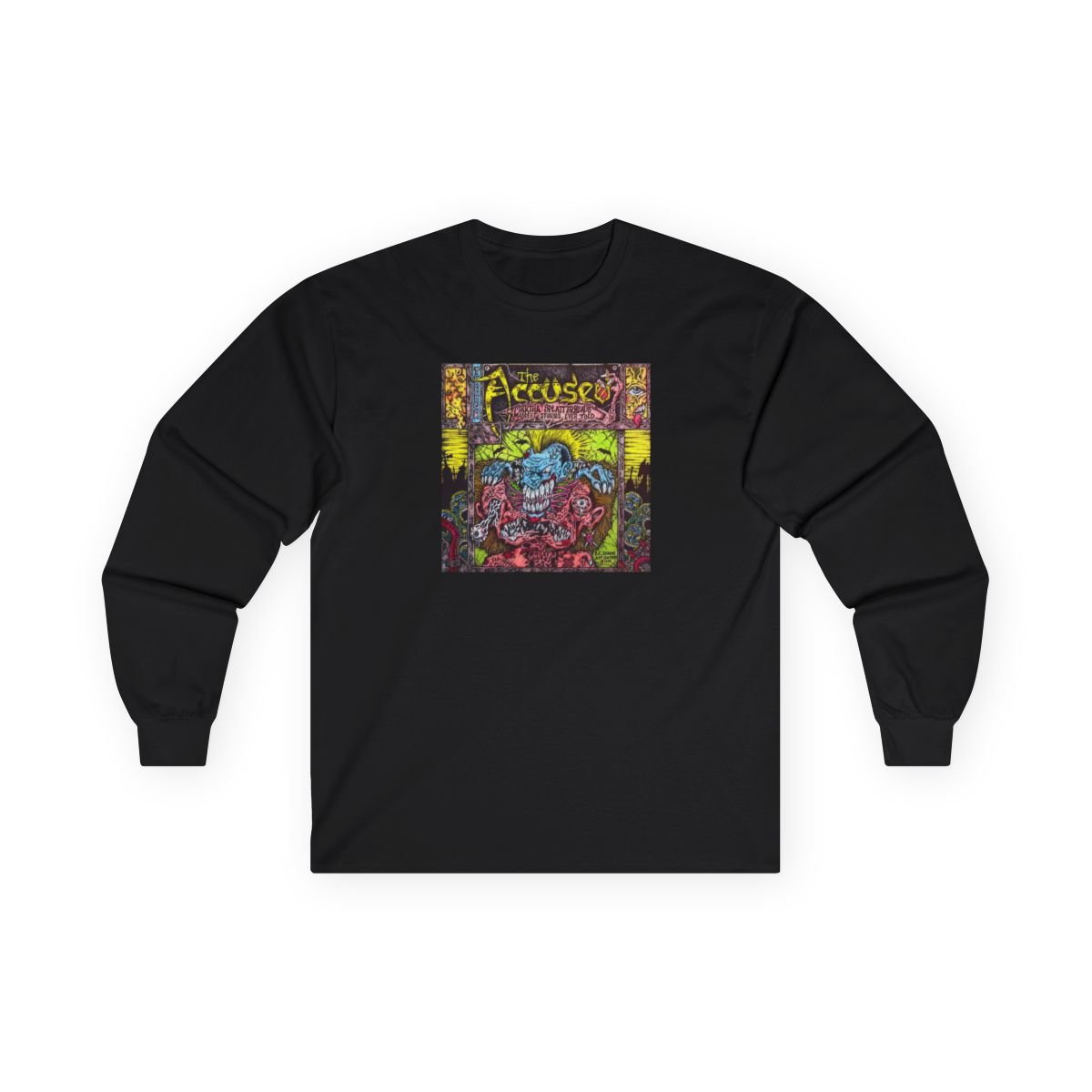
Maddest Stories. If you only know one Accüsed album cover, make it this one. The design is the cover of Martha Splatterhead's Maddest Stories Ever Told, with a blue zombie bursting from gore. The Maddest Stories long sleeve tee is the one to pick for anyone who likes their band shirt to double as a record lesson, and long sleeves work well for cold-night shows.
The Return Of... A spiky-haired ghoul stalking out of a ruined gothic cathedral, all in stone grey. The name echoes the 1986 album The Return of Martha Splatterhead, and the muted grey makes it one of the easier pieces to wear every day.
Graveyard Ghoul and Green Ghoul. One is a rotting long-haired zombie woman crouched over skulls and broken gravestones; the other is a slime-green, one-eyed ghoul gripping a knife above a blazing logo. Both are Martha-style horror at full volume, made for the person who wants the loudest shirt in the room.
Grin. The horned logo over a wild-haired face with narrowed eyes and a fanged grin. It is the simplest design in the range, and its clean look makes it a good first piece, and it comes in youth sizes too.
Knives and Panic in the Casket. A grinning punk head over two crossed bloody knives, and a mint-and-red collage of skeletons, severed heads and a giant eyeball. These are the deep cuts of the collection for anyone who already owns a Fiend skull and wants something stranger.
How do these pair with a Misfits piece?
Think of it as a double bill of horror punk, one from each coast.
- Cold-weather layers: a Misfits Brush Lettering hoodie under a jacket, with the Accused AD Graveyard Ghoul hoodie as the swap for the next day.
- The two mascots: a Fiend skull piece next to the Maddest Stories design gives you both of horror punk's best-known faces, the Crimson Ghost and Martha Splatterhead.
- For the holidays: both brands have a knit-style Christmas hoodie, red lettering between rows of pixel trees with gift boxes on the back, if you want a festive pair that still looks like it belongs at a show.
- For younger listeners: the Accused AD Grin youth hoodie sits nicely beside the Misfits Jack-o'-Lantern Face kids tee.
Splatter rock and horror punk grew from the same love of late-night monster movies, turned up loud. If that is your kind of night, start with Martha's stories, then look through the Misfits collection for a Fiend to keep her company.